


Mount Vesuvius: A Living Legend
One of the most famous volcanoes in the world, whose dramatic history has shaped science, culture, and the heartbeat of Naples.
Mount Vesuvius is internationally renowned for its raw, destructive power. Its catastrophic eruption in 79 AD is not only the most famous in history, but it also represents the first written eyewitness account of a volcanic eruption in the Western world—marking the very birth of modern volcanology at the foot of this mountain. Its last eruption occurred in 1944, after which the volcano entered a resting phase while remaining strictly active.
For the people of Naples, Vesuvius is a profound contradiction: it is both the beloved symbol of the entire gulf and a constant, powerful reminder of nature’s unpredictability, with millions living in its shadow.
Countless stories and legends surround the volcano. Beyond the tragic fates of Pompeii, Herculaneum, and Stabiae, local folklore tells of San Gennaro, the patron saint of Naples. Legend says the saint miraculously stopped advancing lava from consuming the city, a protection commemorated through historic religious traditions passed down through generations.
Vesuvius National Park & The Somma-Vesuvius Complex
Established in 1995, the Vesuvius National Park protects a vast and fascinating volcanic ecosystem. Structurally, it is a complex known as the Somma-Vesuvius system.
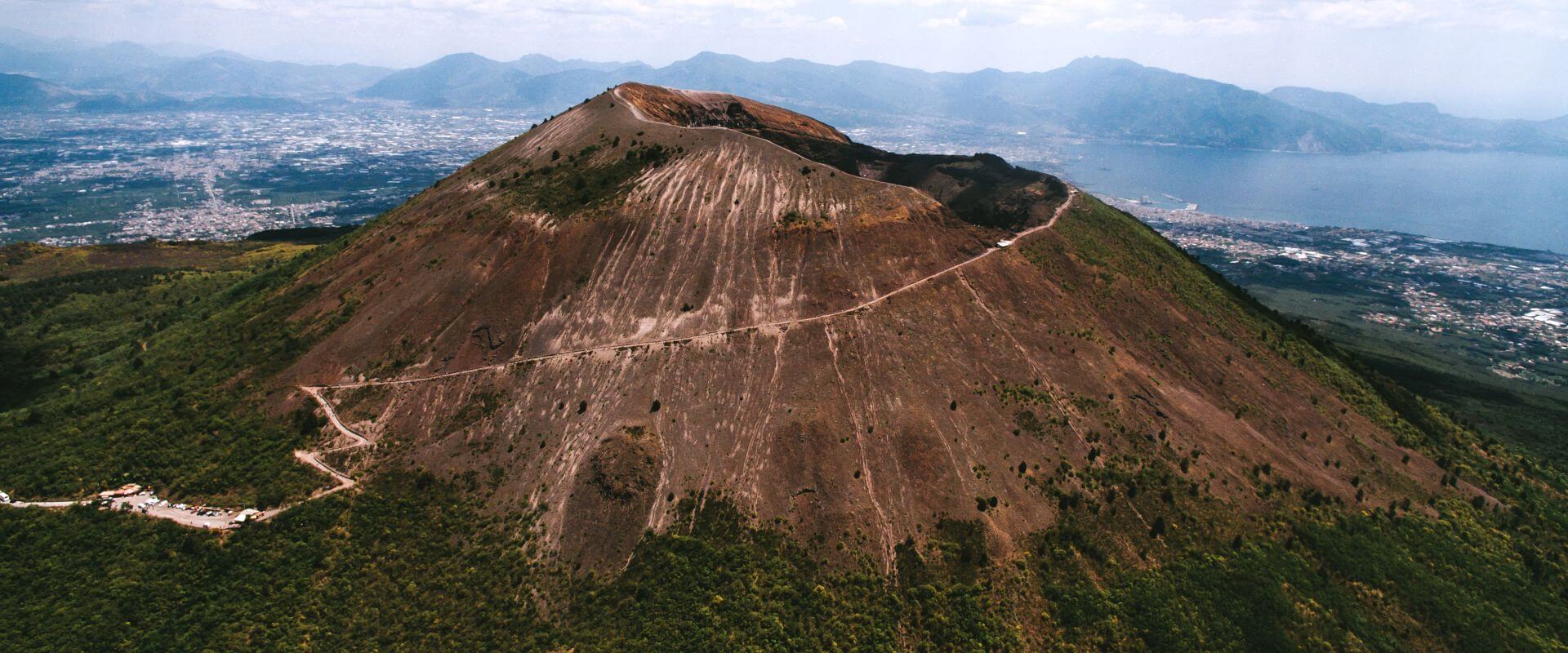
Mount Somma is the ancient, weathered remnant of a much older volcanic building dating back over 25,000 years. Encircled by its steep ridge lies the younger “Gran Cono” (Great Cone), which emerged over the last few centuries—with some historical hypotheses pointing directly to the aftermath of the 79 AD event.
While the central summit has served as the primary vent for centuries, historical evidence shows that eruptions and lateral fissures have frequently opened along the flanks, releasing gas, ash, magma, and pyroclastic material.
🌋 Geological Profile
Vesuvius features a distinctive “humpbacked” silhouette: a large active cone (Gran Cono) partially framed by the dramatic, high-walled rim of the ancient Mount Somma caldera, created by the massive structural collapse of a much taller prehistoric predecessor.